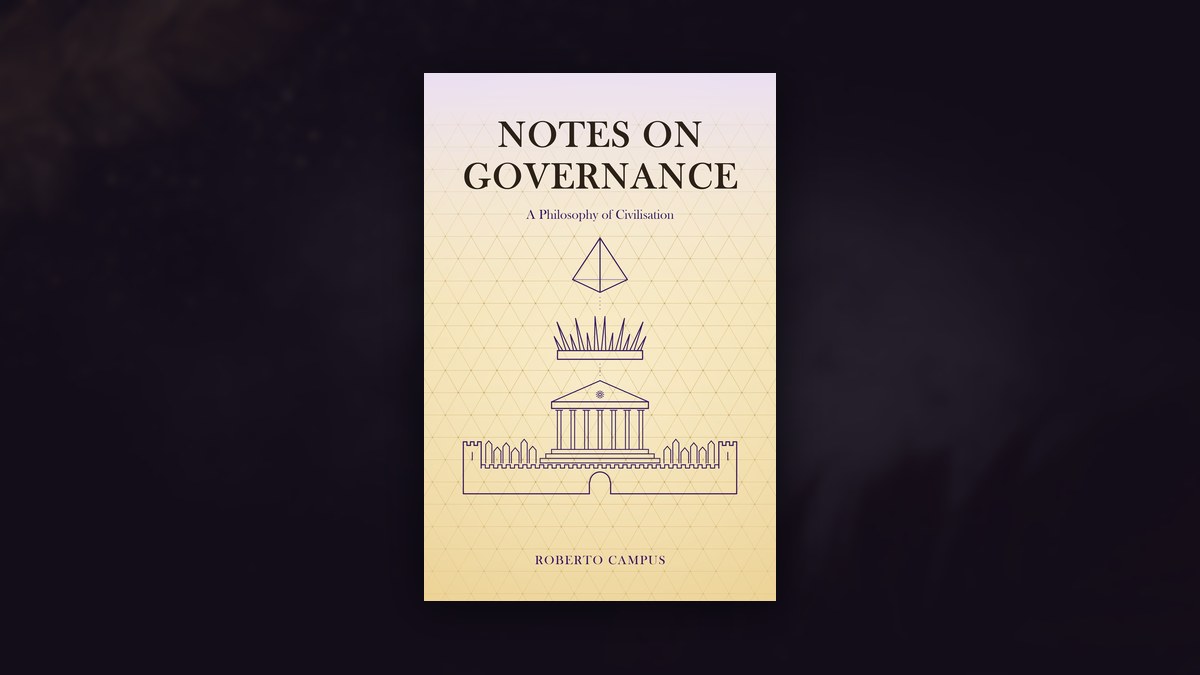
My new book, Notes on Governance: A Philosophy of Civilisation, is on Amazon KDP.
Every political order we have tried has ended in the hands of people it was built to restrain. I reject every one of them as a foundation for the next civilisation, including mass democracy, dynastic monarchy, theocracy, state socialism, and rule by concentrated wealth. What could we build if we took seriously what thousands of years of history have taught us about who seeks power and what they do with it?
The laws began in a novel
It started with a problem in The Sigma Emperor. If we discovered a source of energy abundant enough to change how everyone on Earth lives, what would keep a handful of people from deciding who gets to use it? I wrote twenty-nine laws for the civilisation that takes shape in the novel. I called them the Edicts and gave them to the founders to proclaim on the Palatine Hill.
Working out who could hold power, and how they could lose it, gave the system a life of its own. It drew on things I’d been thinking about for years, from the Roman idea of the city as a trust passed from one generation to the next to the distributist argument for property held widely enough that households can stand on their own feet. Each Edict now had to answer for itself. What does it protect? What does it cost? How would someone in power get around it? The work of answering those questions deserved a book of its own.
What the record taught me
Rome had a dictatorship meant to be temporary. Sulla marched his troops into the city and later secured the office without a fixed term. More than two thousand years later, Soviet planners diverted the rivers feeding the Aral Sea to irrigate cotton and other crops. The fields got their water and the sea shrank. Each case made me ask who could enforce a limit when the people making the decision had the means and the reason to push past it. Appian’s Civil Wars. NASA’s record of the Aral Sea.
Look at money and the same distance opens up. In the years leading to the 2008 crisis, a lender could make a mortgage and sell it on. People up the chain could collect their fees long before the family made its last payment. That is why the Edicts make named people answer for the businesses they own and put a debtor’s home and freedom beyond the reach of a creditor. The Financial Crisis Inquiry Report.
One Emperor, many cities
Picture a city where the temple houses the assembly and the generator that keeps the lights on. Cities like this make their own laws. The design does away with nation-states, national armies, secret services, and central banks. One Emperor holds the few powers no city can exercise alone, and is charged with carrying human life beyond Earth. He can be removed, has no power to make laws for a city, and cannot pass the crown to an heir.
Everyone is screened continuously for fitness to hold power, including the Emperor. Their thoughts, memories, and beliefs are off limits. The people who govern may live on no more than the median household they govern, and their decisions go on the public record. Machines may calculate. They have no authority to judge a person.
The full design depends on two open research questions from my work in physics. One is how to make energy abundant enough that nobody can govern through the meter. The other is how to establish fitness for office reliably enough for a finding to bind even the person who holds the crown. Some Edicts could start in a city today. Publish the reasons for major decisions and account for what they leave the seventh generation. Set a legal limit on how much water can be taken from a river. Give the people who live downstream the right to enforce it.
What a civilisation is for
There’s a kitchen in the book where a girl hasn’t touched her soup and a neighbour who usually comes to dinner has left a chair empty. Someone will go and knock on his door. The care in that room is easy to leave out of an account of how a society works. So are the people who do the caring. A civilisation should make room for that work, and its institutions should make sure that a stranger’s need can be heard as readily as a friend’s.
That principle runs through the book’s treatment of work, property, and justice. One Edict asks what it means to give the person who was harmed a say in what happens next. I write, too, about how the sacred can place limits on power, and why freedom of conscience has to protect the person who declines to take part in a city’s rites.
Notes on Governance stands on its own. It contains all twenty-nine Edicts, the record from which I drew them, and the strongest objections I know how to make against them. Start with the one you find hardest to accept. That’s where I’d want the conversation to begin.