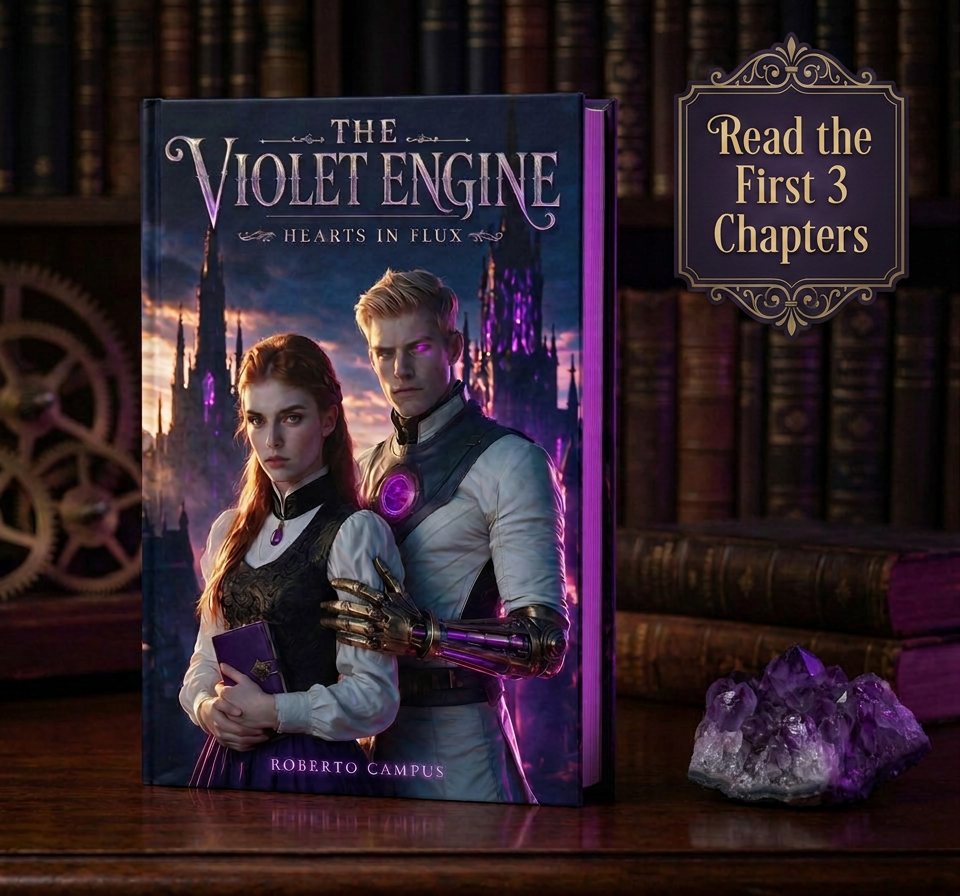
Five months ago I gave one novel a house. There was a second one waiting, and it had been waiting longer.
The Violet Engine — Hearts in Flux is a story I have been writing for several years. Somewhere along the way, the questions I was asking for the book stopped being only for the book, and became the seed of the physics work I now publish as the FLUX Theory. The novel came first. This is where it started.
thevioletengine.com is live.
It has everything a novel should have when it moves out on its own: the cast, the world, the music I wrote alongside the writing, and — the part I actually care about — the prologue and the first three chapters as a free PDF for anyone who joins The Violet Dispatch, the book’s newsletter. Same deal as last time. Email, confirm, read. Nothing else in the envelope.
What waits inside
London, 1943. Not our 1943. Fifty years earlier, history took a different turn: a rift tore open in reality, and out of it came the Flux, an energy that answers, faintly, to the minds around it. The world that grew up on it never needed electricity. The Flux lights the city and drives its machines, and the Violet Order measures it, rations it, and has a word for people who listen to it too closely.
Because the Flux does not only power things. It responds. To attention, to intention, to whatever it is that makes a mind a mind. The Order built a science on it without ever asking what it is. Fifty years on, the instruments agree with each other and none of them agree with reality.
And the rift was not a beginning. The Flux has been here before, under older names, in an age the histories file under myth and the sea has long since closed over. Something from that age is not finished.
Eighteen years ago Edward Lyell sealed his laboratory, gave his granddaughter a pendant, and walked out of the Order by nightfall. The rooms are still sealed. The pendant is still warm. Now Amara Lyell measures the Flux for the Order herself. She trusts instruments over people, asks the questions the Order stopped asking, and has never told anyone what she saw in its garden when she was seven.
Beneath the Order, in the dark, someone wakes with a name and nothing else. One blue eye. One violet. The Flux, which answers to no one, goes still to listen.
Around them: a Council Lord whose perfection is a mask over something changing beneath his skin. A cousin who left the family and the Order in the same year, and now leads the Rift Runners into places the Order pretends do not exist. A man who once sang Puccini beneath La Scala’s ceiling and now moves without a sound. The only doctor in London who treats what the Order says does not exist. A barefoot monk the Council tolerates because it cannot decide whether he is mad. And a Council of seven chairs and six members, where the empty seat is not discussed, and has been polished every morning for fifty years.
It is alternate history and it is science fiction, but underneath it is a book about consciousness and physics and the thin place where they meet: about what happens when a civilisation mistakes the part of reality it can meter for the whole of it, and what is waiting in the part it cannot. It is written in a Gothic register, with more silence than explanation, and it is meant to be read slowly and savoured.
If you read His Dark Materials for the daemons and stayed for the theology, if Jonathan Strange & Mr Norrell felt like a door rather than a book, this one was written for you.
The prologue and the first three chapters are where it begins.